
Why is International E-Waste Day important for your organisation
14 October marks International E-Waste Day, a day that brings the issue of electronic waste to the fore and puts it on the agenda. In this blog, you can read about the scale of the e-waste problem, why a dedicated awareness day is effective, and what your organisation can do with end-of-life IT equipment.

You have probably heard the saying "Never put off until tomorrow what you can do today". Rarely does it ring truer than with discarded laptops, mobile phones and other electronic devices. They get replaced, end up in a dark corner of a cupboard and gather dust there for a few more years until someone decides to clear them out.
That is exactly the heart of the problem with electronic waste: it disappears from view. Since 2018 there has been a fixed day to do something about it: International E-Waste Day.
What is International E-Waste Day
Every year on 14 October, the WEEE Forum organises International E-Waste Day, an awareness day about electronic waste and how to hand it in correctly. 2026 is the ninth edition. Taking part means organisations stage something of their own around e-waste: collection drives, local events, school talks and communication campaigns.
Recupel, the Belgian member of the WEEE Forum, is also taking part this year with the campaign "Fast tech: don't bin it, bring it!". Consumers are asked to search their homes for forgotten or broken small appliances and take them to a Recupel collection point.
Organisations with larger quantities of IT, such as laptops, mobile phones and tablets, can also come to us. We processed the devices from Recupel's Re-cup-el campaign, for example.
Who is the WEEE Forum
The WEEE Forum is an international non-profit association, founded in April 2002 by six organisations from Austria, Belgium, the Netherlands, Norway, Sweden and Switzerland. Today it brings together 50 producer responsibility organisations for discarded electrical equipment from 33 countries; Recupel is the Belgian member.
How big is the problem
- The Global E-waste Monitor 2024 counted 62 million tonnes of e-waste in 2022, 82 per cent more than in 2010. Only 22.3 per cent of that was documented as collected and recycled; in Europe the figure was 42.8 per cent. The amount grows five times faster than documented recycling and, according to the report, will reach 82 million tonnes in 2030.
- According to BeWeee, Belgium achieved a collection rate of 66.2 per cent for reference year 2025 (excluding solar panels; including solar panels it is 53.07 per cent), compared with 61.9 per cent in 2024. The EU target is 65 per cent. In 2025 Recupel collected 137,164 tonnes of electrical and electronic equipment (46.5 million devices), of which 7,108 tonnes went to reuse, 11.9 per cent more than a year earlier. That is roughly 5 per cent of the tonnage collected. Reuse ranks higher than recycling in the waste hierarchy, but makes up only a small share of this figure.
Why a fixed day suits this problem
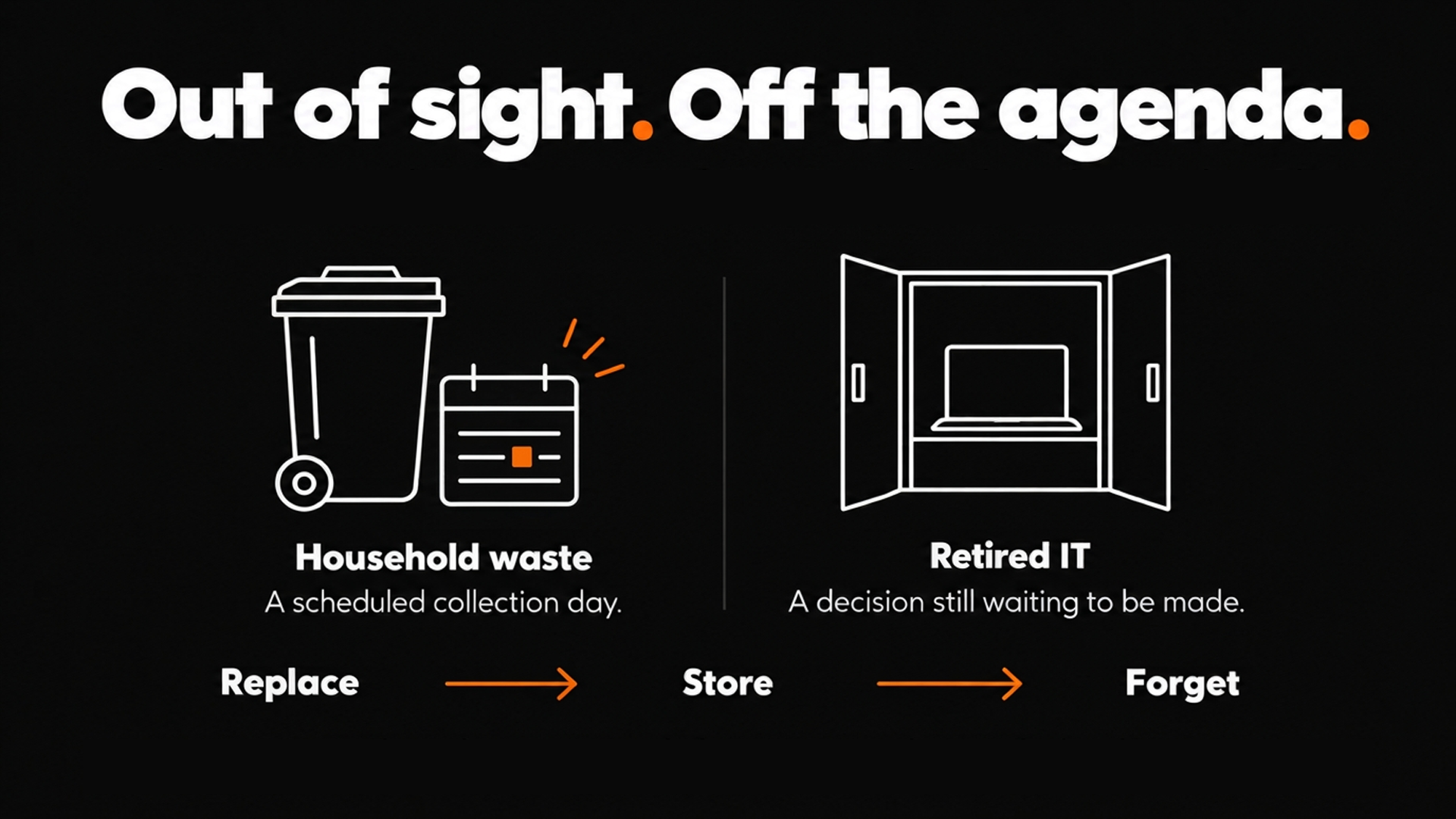
E-waste differs from ordinary waste. Household rubbish has a collection day; a device in a cupboard waits until someone decides to do something with it. Discarding it stays "something for later", because nothing forces the moment.
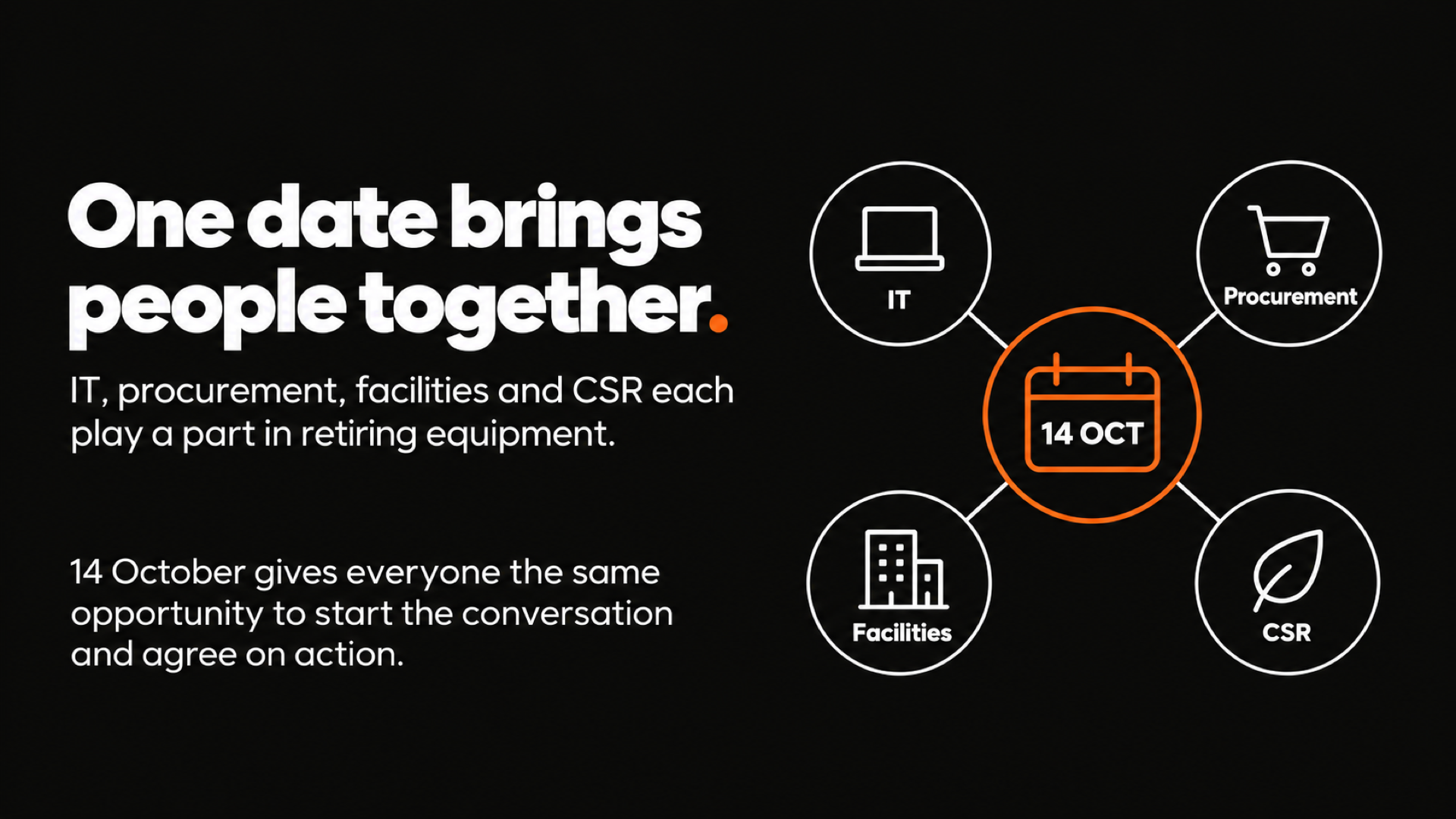
A fixed date turns "one day" into "now". Anyone who opens their cupboards on 14 October has a reason that lies outside their own planning. That counts for extra within an organisation, where IT, purchasing, facilities and CSR each manage a piece of the disposal process and nobody puts the subject at the top of the agenda on their own initiative. A recognisable day gives everyone the same reason to start the conversation.
Repetition adds to the effect. It happens every year on the same day and many organisations communicate about it at the same time, which makes the subject familiar and turns it into a fixed point in the calendar.
What organisations can do with discarded IT
In an organisation, this cupboard is a stockpile that grows with every replacement round. Laptops and mobile phones are replaced regularly through leasing or direct purchase, and every replacement round leaves a new batch of devices behind.
Research by UNITAR and WEEE Forum members in six countries (United Kingdom, Italy, Portugal, Romania, Slovenia and the Netherlands) shows how common this is: an average household had 74 electrical products, of which 13 lay unused (9 working, 4 broken).
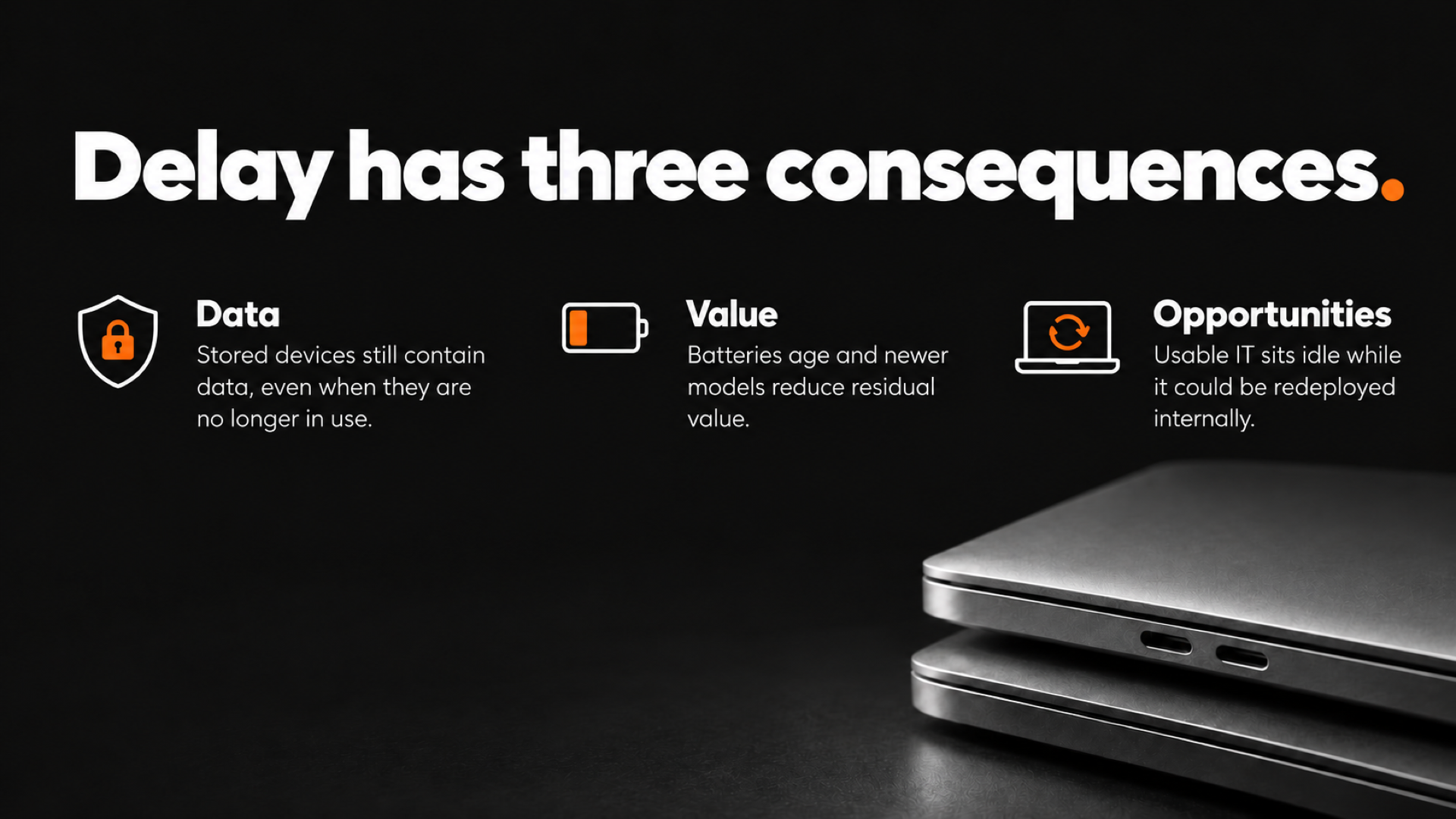
Such a stockpile costs an organisation in three ways:
- Data. A device in a cupboard still holds data, including personal data, and the GDPR requires that it is not kept longer than necessary. How we deal with this is explained on our page on data erasure.
- Value. Batteries age even when unused and newer models keep arriving, so a device that is still perfectly usable today will fetch less next year.
- Opportunities. New hardware is becoming more expensive and scarcer. According to De Tijd, laptop prices at Cegeka rose by more than 50 per cent compared with last year, and according to Beltug delivery times run up to eight months. A usable device in a cupboard is then an internal alternative that nobody uses. You can read more in our article on geopolitical tensions and reuse.
What an organisation does with that stockpile should follow the waste hierarchy: reuse first, then repair, and only then recycling.
That order has a reason. Reuse preserves the energy and raw materials already contained in the device and therefore saves more CO2 than recycling. Recycling recovers metals such as gold, silver, palladium and copper, but always leaves a residual fraction. You can read more about this order in The Lansink Ladder: what the order of waste processing means for your organisation.
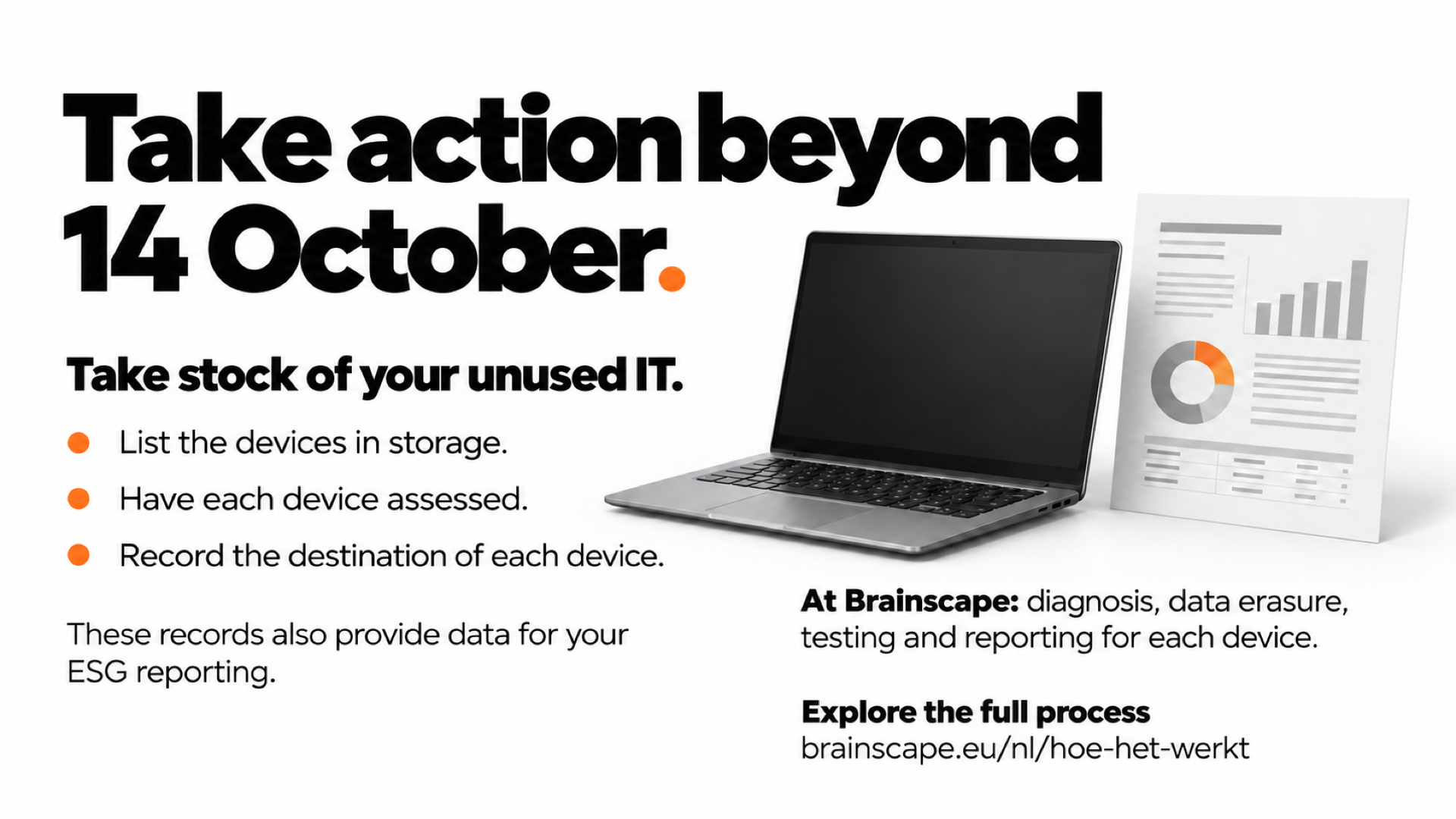
In practice it comes down to three steps:
- map what is lying around
- have each device assessed
- record the destination of each device.
That last step produces data that organisations can use in their ESG reporting.
How we handle discarded IT at Brainscape
Assessing, wiping and reporting is our work as a processor of discarded IT (ITAD). In short:
- Transport: we plan the transport, or you organise it yourself (see transport options). The load travels sealed and on a one-to-one basis. Brainscape is registered by OVAM as a carrier of waste.
- Receipt: on arrival we register the load with a CMR document, weigh it and enter it in the waste register.
- Diagnosis, data erasure and testing: every device is diagnosed, wiped and tested to recognised standards, with a certificate per device.
- Reporting: for each device we record the serial number or IMEI, description, date, test, data erasure, grading and condition. You can consult the reports via the MyBrainscape portal and include the data in your ESG reporting.
- Destination: devices that work fully and have a battery capacity of at least 85 per cent go to reuse. Repairable devices, or devices with a battery capacity below 85 per cent, are refurbished. Whatever can no longer be repaired goes to specialist partners for recycling, where raw materials are recovered.
Our way of working is ISO 9001 and ISO 14001 certified. You will find the overview under Permits and certificates, and in our article on the renewed certifications you can read what that means for your ITAD partner.
Want to know which devices still have value
Want to know what in your current IT estate can still be reused? Get in touch or call +32 (0)3 354 23 23.
Frequently asked questions
When is International E-Waste Day?
Every year on 14 October.
When was International E-Waste Day first established?
The day has been in existence since 2018 and is organised by the WEEE Forum. 2026 will mark the ninth edition.
Who organises International E-Waste Day?
The WEEE Forum, together with its 50 member organisations, including Recupel for Belgium.
What is the difference between reuse and recycling?
With reuse, a device stays in use as a whole and keeps its value. With recycling, materials are recovered and a residual fraction always remains. That is why reuse ranks higher in the waste hierarchy.
What can an organisation do on 14 October?
Check which laptops, mobile phones and tablets are lying unused in cupboards and have them assessed by a processor that tests, wipes and reports on every device. See all our services or contact us directly.


