
Contributing to the SDGs with your IT equipment: here’s how to go about it
Would you like your organisation to contribute to the SDGs? If so, your IT equipment is a practical place to start. In this article, you’ll find a brief overview of what the SDGs are, how IT fits into them, and what steps you can take yourself.

Want your organisation to contribute to the SDGs? Your IT equipment is a very tangible place to start. This article briefly explains what the SDGs are, where IT fits in and which steps you can take yourself.
What are the SDGs
The SDGs (Sustainable Development Goals) are 17 goals that the United Nations adopted in 2015, with 2030 as the deadline. They cover poverty and health, but also climate, clean energy and the responsible use of raw materials. Each goal is broken down into concrete targets, which countries, cities and businesses use as a compass.
For businesses, the SDGs offer a shared framework for showing what you contribute to and which figures back it up. So you talk about a contribution to the SDGs, supported by measurable data. Two goals relate directly to IT equipment: SDG 12 (responsible consumption and production) and SDG 13 (climate action).
Why IT equipment matters
IT equipment combines two things that carry a lot of weight in the SDGs: large volumes of waste and a significant climate impact during manufacturing.
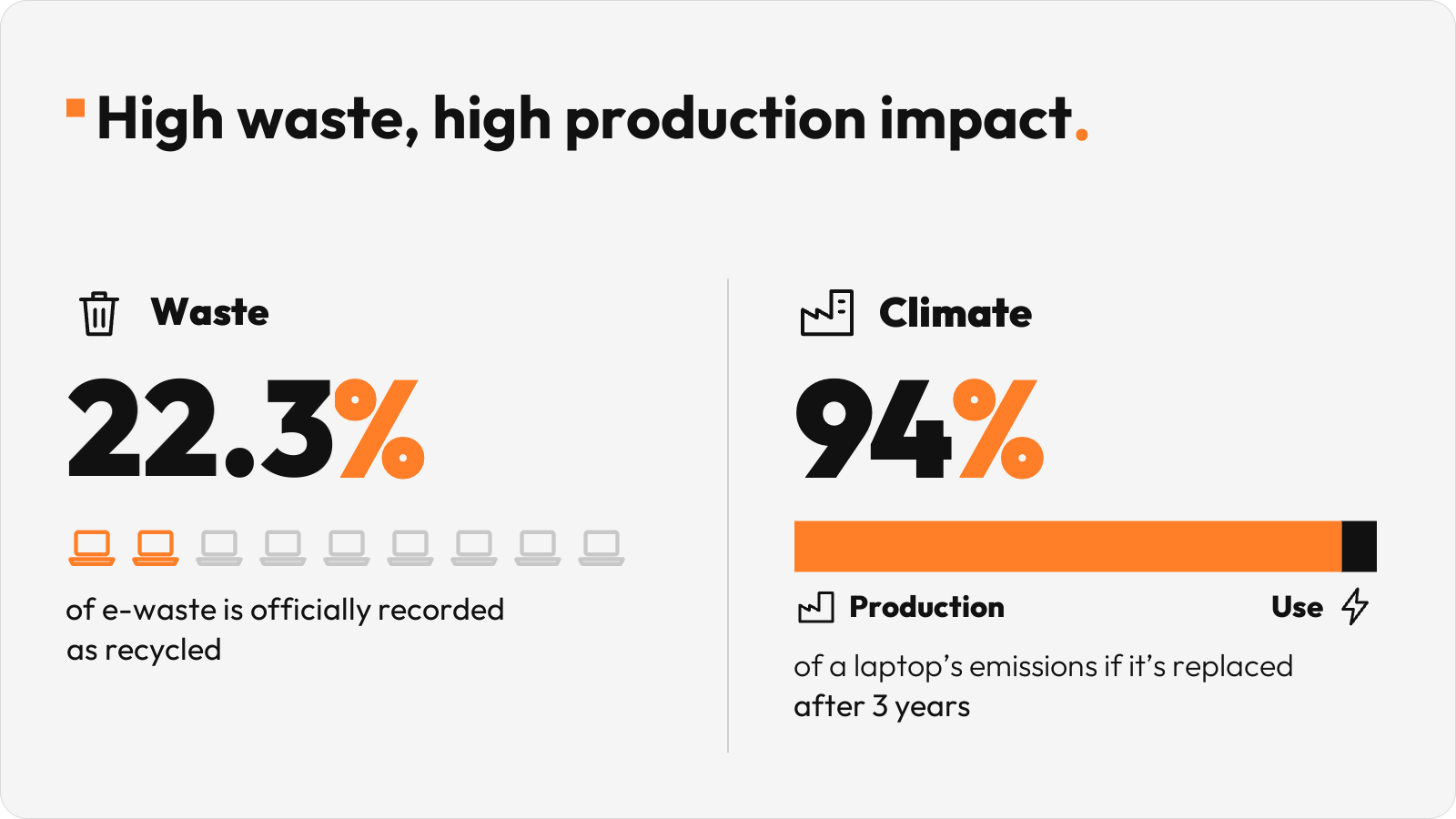
- Waste. In 2022, the world generated 62 million tonnes of e-waste. Only 22.3% of it was documented as properly collected and recycled, according to the Global E-waste Monitor 2024 by the ITU and UNITAR. For small IT and telecoms equipment such as laptops, mobile phones and routers, the figure is 22%. Europe performs best at 42.8%, but still falls short of half.
- Climate. According to TCO Certified, a new laptop has already generated around 250 kg of greenhouse gas emissions before you switch it on for the first time. If it is replaced after three years, 94% of its total emissions come from manufacturing. The exact share varies by device and by source (in its own analyses, manufacturer Dell puts it at between 68% and around 80%), but manufacturing accounts for the largest share in standard life cycle assessments.
SDG 12 and IT: reuse before recycling
SDG 12 is about responsible consumption and production. Two of its targets are particularly relevant to IT:
- Target 12.5: by 2030, substantially reduce waste generation through prevention, reduction, recycling and reuse.
- Target 12.6: encourage companies to adopt sustainable practices and to include sustainability information in their reporting.
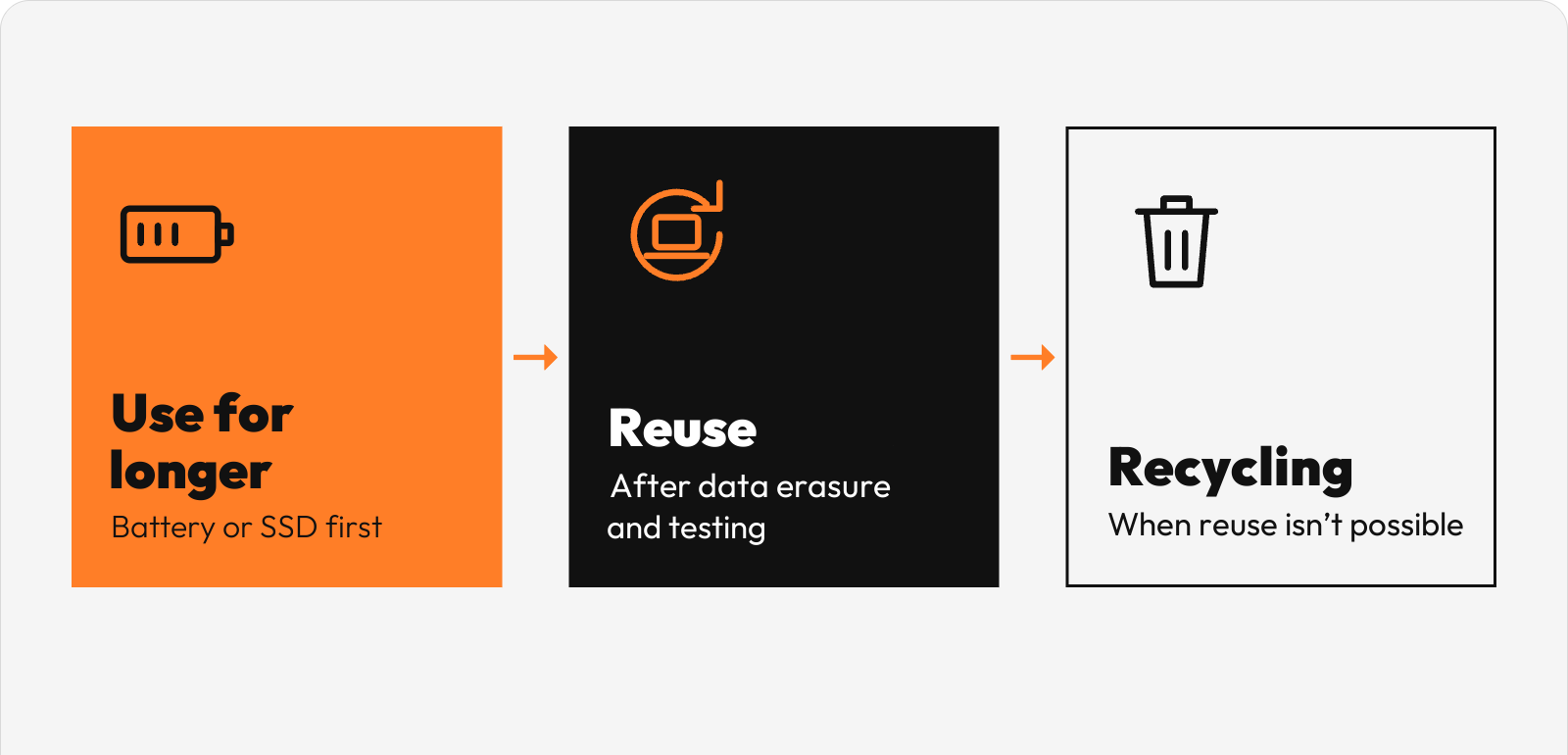
For your IT equipment, that means a clear order of priority: keep using it for longer first, then reuse, and only then recycle. That is the principle of reuse before recycling. Recycling recovers raw materials, whereas reuse avoids a new device having to be made in the first place. Equipment that still works gets a second life after thorough data erasure and testing. Devices that can no longer be reused go for recycling.
Target 12.6 is about what you can demonstrate: how many devices were reused, how many were recycled and what happened to the data. Without those figures, your contribution remains a claim.
SDG 13 and IT: longer use, less new production
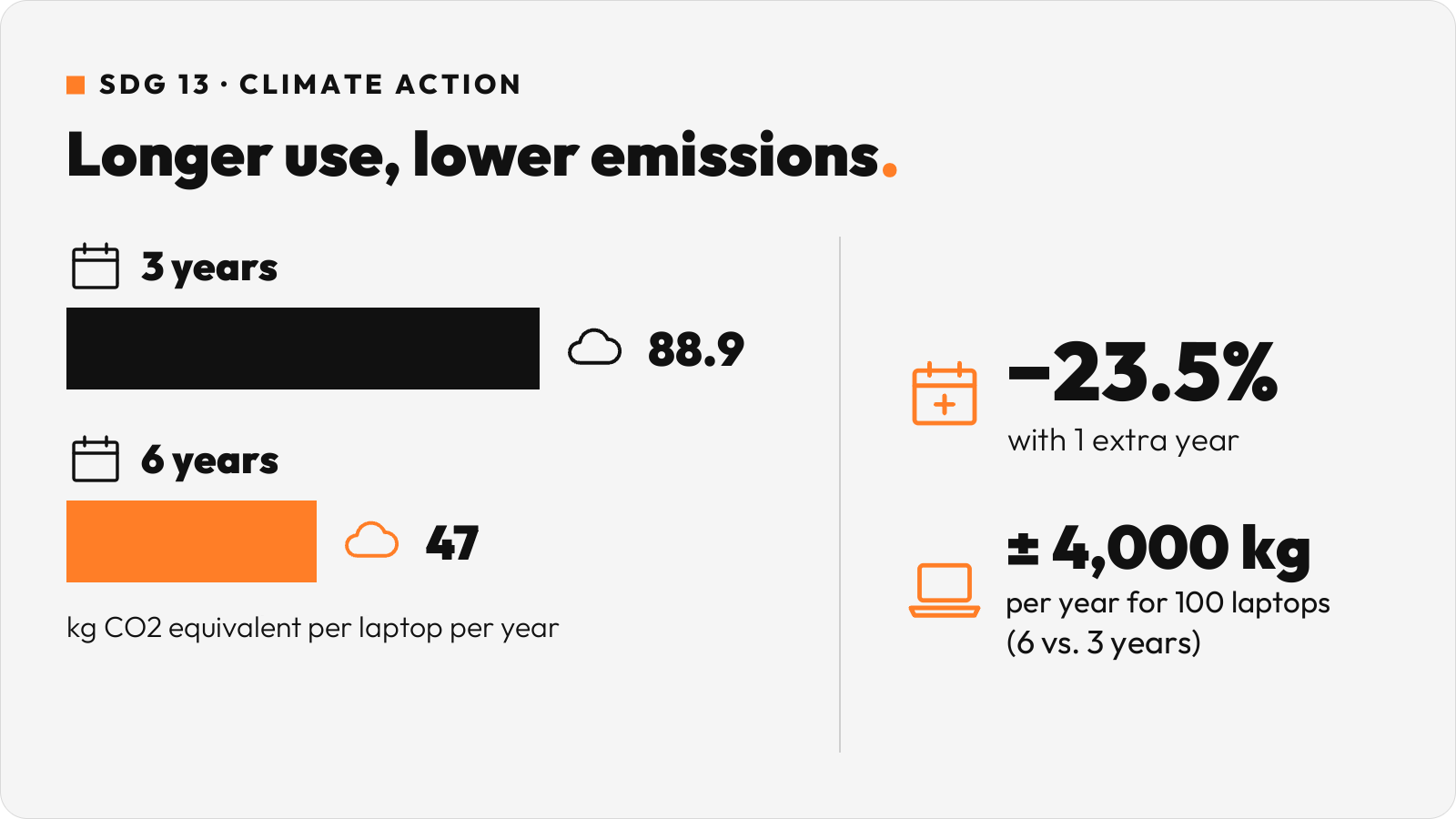
SDG 13 is about climate action. With IT equipment, your replacement cycle is the biggest lever. According to TCO Certified, a laptop's annual emissions fall from 88.9 kg to 47 kg CO2 equivalent if you use it for six years instead of three. Across 100 laptops, that is more than 4,000 kg less a year. Even one extra year makes a difference: four years instead of three cuts annual emissions by 23.5%.
This works as long as devices remain secure and supported, with updates, a replaceable battery and repairable parts. And when a device does reach the end of its first life in your organisation, reusing it elsewhere means a new one does not have to be manufactured.
How to contribute to the SDGs with your IT equipment
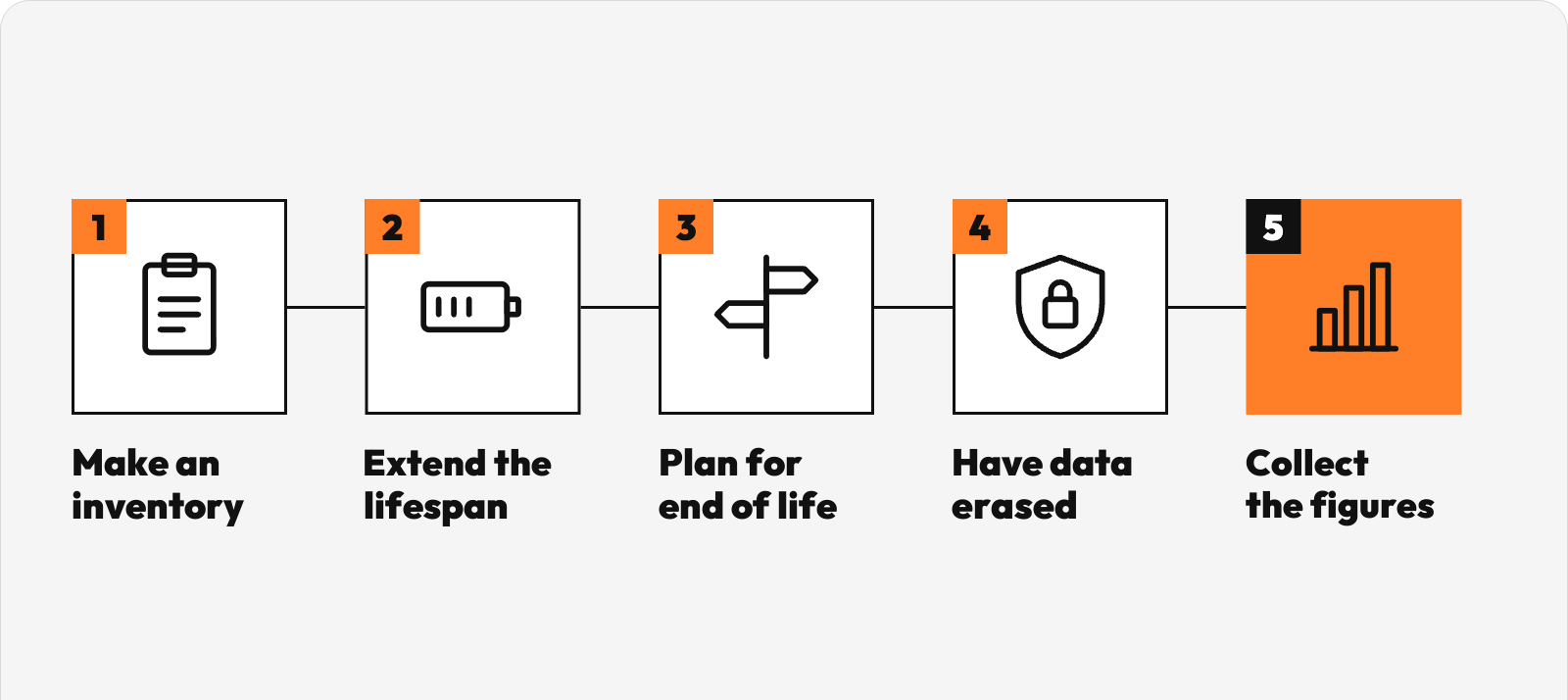
- Take stock. Which laptops, mobile phones, servers and peripherals do you have, how old are they and where are they?
- Extend their lifespan where you can. Replace a battery or an SSD before replacing an entire device, and stay on top of updates.
- Decide in advance what happens at the end of their first life. Internal redeployment, reuse through a specialist partner and recycling each need their own arrangement.
- Have data erased before a device leaves your organisation. Ask for proof of data erasure and keep it on file.
- Gather the figures. How many devices were reused, how many were recycled and what did they weigh? These figures substantiate your contribution to SDG 12 and SDG 13.
Do you need to report on this
For most organisations, reporting on the SDGs is a matter of choice. Since the 2026 Omnibus Directive, the CSRD, the EU's sustainability reporting legislation, only applies to companies with more than 1,000 employees and more than €450 million in turnover. That is an estimated 5,000 companies, compared with the 50,000 originally expected (source: Dcycle). In July 2026, the European Commission also adopted the simplified ESRS, alongside a voluntary standard for companies outside the scope of the CSRD.
If you are above those thresholds, work with the person responsible for your reporting to identify which data points in the simplified ESRS relate to your IT equipment. If you are below them, banks, customers and investors often still ask for sustainability data, in practice frequently based on that voluntary standard, which builds on the VSME. Data on the reuse, recycling and data erasure of your IT equipment can feed straight into it.
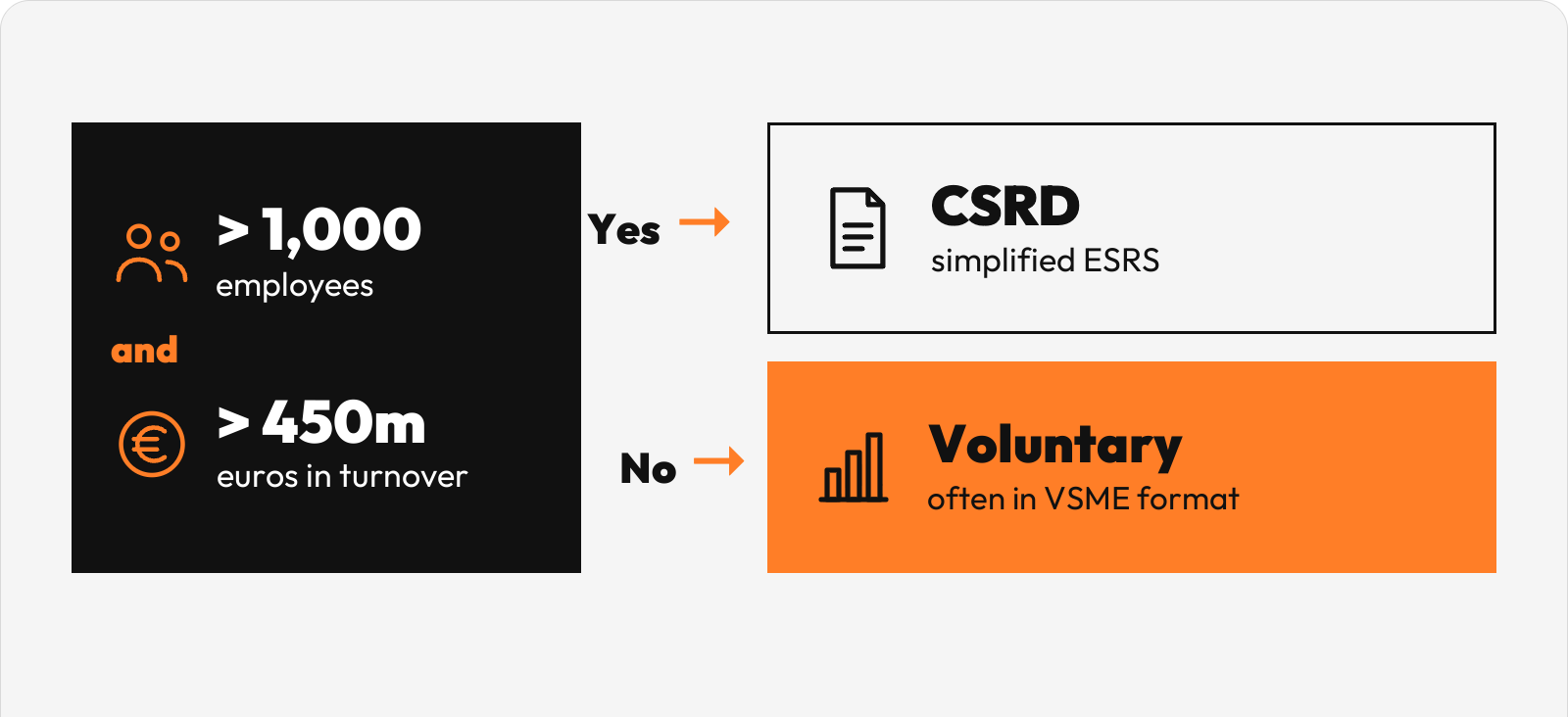
The rules are changing quickly. Check the latest position with your accountant or on EUR-Lex.
How Brainscape helps
Brainscape is a Belgian circular ITAD (IT Asset Disposition) company based in Schoten. We take in your end-of-life IT equipment, erase the data, test what can still be used, ensure reuse wherever possible and recycling where necessary, and provide a report you can use to back up your figures. Each step links to an SDG target:
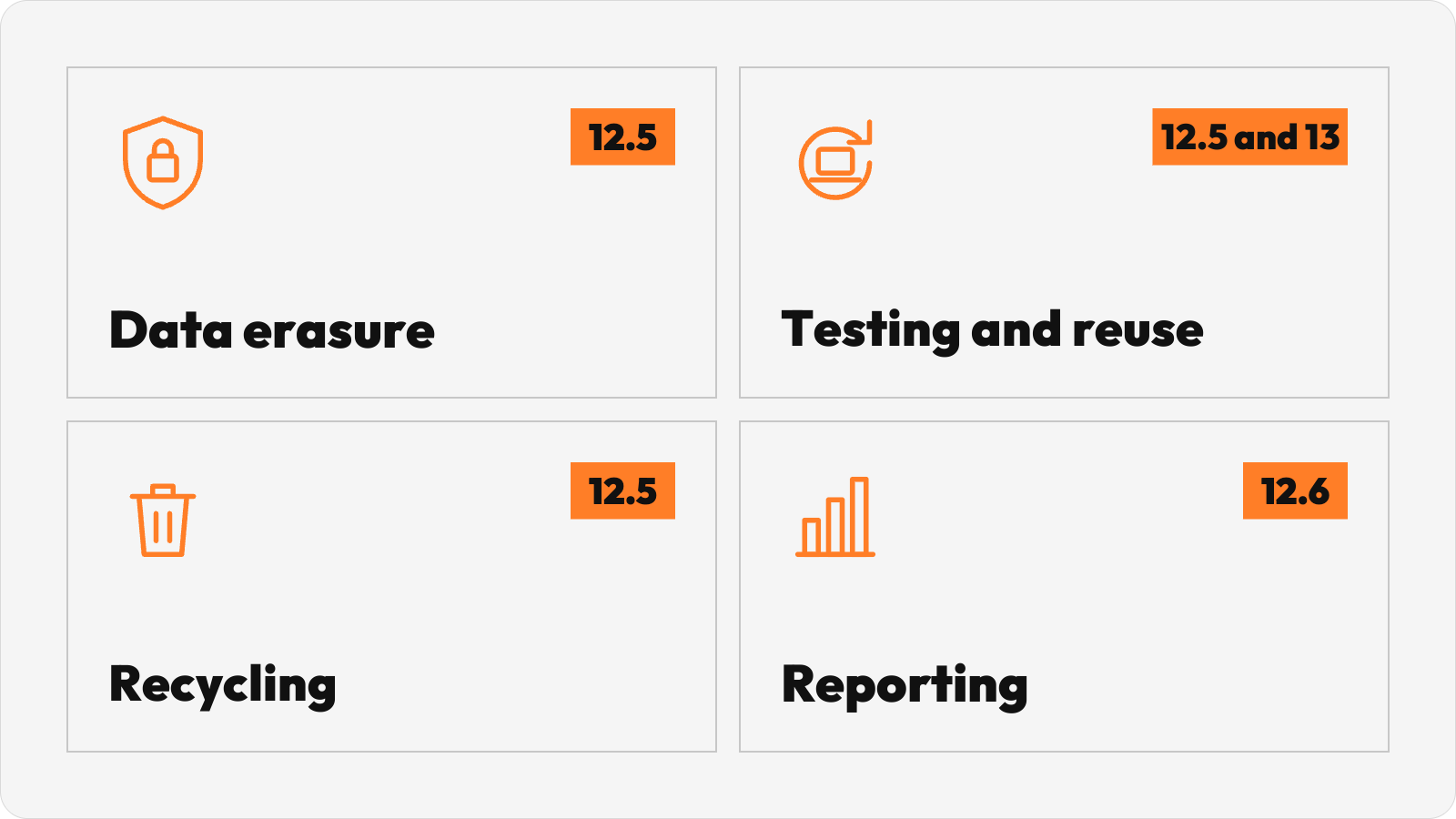
In your own reporting, present this as a contribution to the SDGs, backed by your own data. You can find out more about what we collect on our What we collect page.
Frequently asked questions
Which SDGs are most relevant to IT equipment?
SDG 12 (responsible consumption and production), particularly targets 12.5 and 12.6, and SDG 13 (climate action).
Does my company have to report on the SDGs?
The SDGs themselves are voluntary. Mandatory reporting runs through the CSRD, which since the Omnibus only applies to companies with more than 1,000 employees and €450 million in turnover.
What is the difference between reuse and recycling?
With reuse, the device stays in use and no new one has to be made. With recycling, raw materials are recovered from the device. That is why reuse comes first.
What happens to the data on end-of-life devices?
Data must be erased before a device is reused or recycled. Make sure the erasure is documented, so you can prove it.


